Many Tentacles, One Vision: How Craft Producers Are Expanding Their Portfolios Without Losing Their Soul
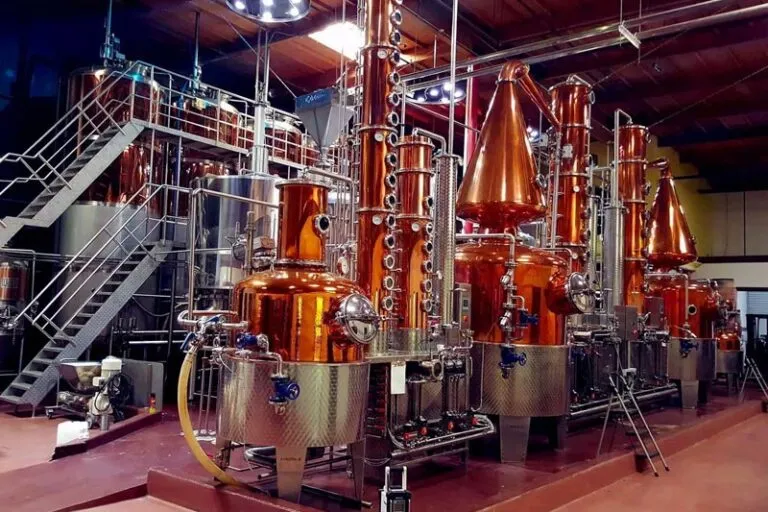
Photo: craft distillery small batch spirits bottles production facility, via www.micetcraft.com
There is a particular kind of ambition that defines the best independent craft producers in America today. It is not the ambition of volume or market dominance. It is something closer to curiosity—a restless desire to follow an idea wherever it leads, even when that means venturing well beyond the spirit or wine that first put a name on the map.
At Eight Arms Cellars, we have long believed that the most compelling bottles tell a story larger than their contents. Increasingly, that story is unfolding across entire portfolios, as forward-thinking distilleries and wineries reach into adjacent categories with the same deliberate care they once reserved for their flagship releases. The results are sometimes extraordinary. Occasionally, they are instructive failures. Almost always, they are worth paying attention to.
The Logic Behind the Leap
For a small-batch producer, the decision to diversify is rarely purely financial—though economics certainly play a role. A distillery operating a single-malt whiskey program, for instance, must wait years before its core product reaches maturity. Secondary lines, whether a white dog expression, a botanical gin, or a cask-finished brandy, generate revenue during those long intervals and keep a distillery's name on back bars and retail shelves.
But the motivation often runs deeper than cash flow. Many producers describe a kind of creative overflow: the equipment is there, the grain or fruit is arriving seasonally, and the team's palate has been sharpened by years of iterative blending. The question stops being why diversify and starts becoming why not.
"We had been making rye whiskey for four years when we started noticing what the barrels were doing to a small batch of pear brandy we'd set aside almost as an experiment," explains one Pacific Northwest distiller who asked to remain unnamed pending a formal release announcement. "The rye had conditioned the wood in a way that gave the brandy this incredible spiced quality—clove, dried orange peel. We couldn't have planned it."
That serendipity is a hallmark of the most successful portfolio expansions. Rather than engineering a secondary product from market research alone, the strongest new releases tend to emerge organically from a producer's existing infrastructure, ingredient relationships, and accumulated knowledge.
When Expansion Becomes Overextension
Not every foray into new categories ends in a celebrated discovery. The craft beverage industry is littered with cautionary tales of distilleries and wineries that mistook enthusiasm for strategy.
A distillery in the upper Midwest that built its reputation on a single, meticulously sourced corn whiskey spent three years developing a line of five botanical spirits simultaneously. The result, by the distillery's own candid admission, was a dilution of focus that nearly cost them their flagship program. "We were chasing novelty when we should have been chasing excellence," the founder said at a 2023 industry panel. "We had to pull back, discontinue three of the five expressions, and remind ourselves what we were actually good at."
This tension—between creative ambition and operational discipline—is perhaps the defining challenge of portfolio expansion. The analogy is almost uncomfortably apt for a brand like ours: an octopus can extend eight arms simultaneously, but each one requires coordination from a central intelligence. Without that coherent governing vision, the reach becomes a tangle.
Industry consultant Margaux Delacroix, who works with independent producers across the Southeast and Mid-Atlantic, frames it this way: "The question I always ask a client is not 'Can you make this?' but 'Can you make this well, consistently, at scale, without pulling resources from what already works?' Those are three very different thresholds."
Herbal Liqueurs and the New American Apothecary
Among the most fertile areas of portfolio expansion in recent years has been the American herbal liqueur—a category once dominated by European legacy brands that is now attracting some of the most inventive minds in domestic craft production.
Producers from Vermont to New Mexico are drawing on regional botanicals—elderflower, sumac, Douglas fir tips, sagebrush—to create liqueurs that function as both standalone digestifs and versatile cocktail components. For distilleries with an established spirits identity, these releases serve as a kind of bridge, introducing their palate philosophy to a broader audience through a more approachable, lower-proof format.
High Wire Distilling Co. in Charleston, South Carolina, offers an instructive model. The distillery built its reputation on heirloom grain whiskeys and agricole-style rum before introducing Amaro Medicinale, a Southern-inflected bitter liqueur incorporating locally sourced botanicals. Rather than departing from the brand's identity, the amaro extended it—demonstrating that the same obsessive sourcing philosophy applied to grain could be applied equally to botanicals.
The pairing possibilities this opens are significant. An herbal liqueur produced by the same hands that craft a rye whiskey creates natural affinity on the palate and coherent storytelling on the menu. Bartenders and sommeliers, increasingly sophisticated in their appreciation of provenance, have responded warmly.
The Winery Perspective: Brandy, Pet-Nat, and Beyond
The calculus is somewhat different for wineries considering portfolio expansion, but the underlying principles hold. American wine producers, particularly those working with estate fruit in regions like the Finger Lakes, the Willamette Valley, and the Sierra Foothills, are finding compelling reasons to explore brandy production, piquette, and even fruit-forward vermouths made from their own surplus harvests.
Brandy, in particular, represents a natural extension for a winery with both the fruit and the distillation permit. California's Osocalis Distillery—founded by a winemaker—demonstrated years ago that the two disciplines could coexist under one roof with remarkable results. Younger producers are now following that precedent, using brandy programs as a vehicle for exploring what happens to their estate character when fermentation gives way to distillation and wood aging.
The risk, as with distillery expansion, is one of identity diffusion. A winery celebrated for precise, cool-climate Pinot Noir must be careful that a brandy program doesn't muddy the consumer's understanding of what the brand represents. The solution most successful producers have found is transparency: releasing secondary products under clearly differentiated sub-labels or through tasting room exclusives, allowing the core wine program to remain the primary narrative.
Discipline as a Creative Act
Perhaps the most counterintuitive lesson from the producers who have navigated portfolio expansion most successfully is this: restraint is itself a form of creativity. Knowing which ideas to pursue—and which to set aside, however reluctantly—is as much a craft skill as blending or fermentation.
The best small-batch producers treat their portfolio the way a skilled editor treats a manuscript: with enthusiasm for what is genuinely strong and the willingness to cut what is merely interesting. In doing so, they preserve the coherence that makes their work worth seeking out in the first place.
For connoisseurs, this means that a new release from a trusted producer carries real weight—a signal that something has earned its place in the lineup. For casual enthusiasts just beginning to explore the craft beverage landscape, it is an invitation to trust that the name on the label means something beyond marketing.
The reach, when it is purposeful, is always worth following.