Brine, Kelp & Copper: A Connoisseur's Guide to Coastal Craft Spirits and Seafood Pairings
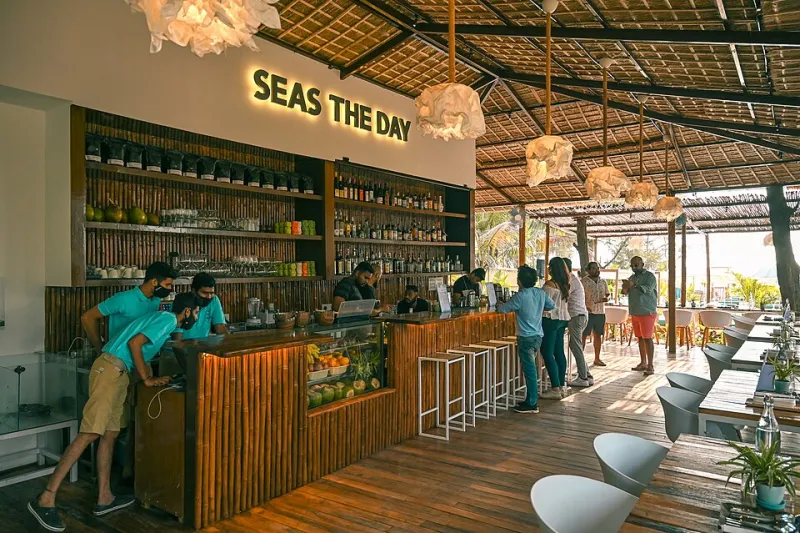
Photo: FelixGoaAnjuna, CC BY-SA 4.0, via Wikimedia Commons
Brine, Kelp & Copper: A Connoisseur's Guide to Coastal Craft Spirits and Seafood Pairing
There is a moment, familiar to anyone who has shucked an oyster at the edge of a Maine dock or pulled a net of Dungeness crab from the cold waters off the Oregon coast, when the sea itself seems to arrive on the palate — a rush of salt, mineral, and something almost metallic that is impossible to manufacture and equally impossible to forget. The best coastal craft spirits are chasing precisely that sensation, and an increasing number of American distillers are getting remarkably close.
At Eight Arms Cellars, we celebrate beverages that carry a sense of place — liquids that communicate something true about the land, or in this case, the water from which they draw their character. The emerging category of marine-inspired spirits deserves serious attention, not as a novelty but as a genuine expression of terroir translated into distillate.
The Science of Marine Flavor in Spirits
Understanding why certain spirits taste oceanic requires a brief excursion into chemistry. The briny quality associated with coastal environments derives primarily from sodium chloride, but the more nuanced marine notes — the iodine-tinged, almost medicinal quality of a good Scottish island whisky, or the umami depth of a seaweed-infused gin — come from compounds called halogenated anisoles and dimethyl sulfide, both of which occur naturally in marine algae and sea-spray-exposed environments.
Distillers capturing these flavors employ several methods. Some use direct botanical infusion, steeping dried kelp, dulse, or bladderwrack in neutral spirit before redistillation. Others rely on water sourced from coastal aquifers or desalinated sea water, allowing mineral content to influence the base. A third, more subtle approach involves aging in warehouses exposed to ocean air, a technique long employed by Scotch distilleries on Islay and now being adopted by forward-thinking American producers in coastal Maine, California, and the Pacific Northwest.
Seaweed-Infused Gins: The Vanguard of the Category
Gin, with its broad botanical latitude, has proven the most hospitable vehicle for marine flavors. The genre's defining example may be Bimber Distillery's approach in London, but American producers have developed their own compelling interpretations.
Maine Craft Distilling's Chesuncook Gin incorporates locally harvested dulse alongside more traditional botanicals, producing a spirit with a savory, almost dashi-like quality beneath its citrus and juniper structure. It is a gin that demands to be served with food — specifically, with a raw bar. Shucked oysters with a mignonette made from Chesuncook-based gin and champagne vinegar represent one of the more elegant applications of the pairing principle.
Westward Whiskey's American Single Malt, produced in Portland, Oregon, does not position itself as a marine spirit, yet its warehouse location near the Columbia River estuary lends the spirit a subtle mineral quality that bridges the worlds of whiskey and coastal terroir beautifully. Served alongside grilled octopus dressed with smoked paprika and sea salt, the pairing achieves a kind of harmonic resonance — the spirit's malt sweetness playing against the char and brine of the cephalopod in a way that elevates both.
Vodka and the Case for Mineral Purity
Conventional wisdom holds that vodka should be neutral — a blank canvas. The coastal craft movement challenges that assumption directly. Tito's Handmade Vodka, while not explicitly marine in its marketing, has long benefited from the mineral-rich water of the Texas Hill Country, and a growing number of consumers have noticed that its clean, slightly soft profile pairs remarkably well with seafood.
More explicitly oceanic is Ocean Vodka, produced in Maui, Hawaii, using deep-ocean mineral water drawn from 3,000 feet below the surface. The resulting spirit carries a faint but perceptible salinity that makes it an exceptional base for a classic Dirty Martini — particularly when paired with chilled shrimp cocktail or a platter of Pacific oysters. The deep-ocean water, rich in trace minerals including magnesium and potassium, imparts a roundness to the spirit that distinguishes it clearly from grain-neutral alternatives.
Liqueurs and the Umami Frontier
Perhaps the most adventurous corner of the marine spirits category involves liqueurs that embrace umami as a flavor principle. Empirical Spirits, a Danish-American collaboration with distribution across major US markets, produces a series of experimental liqueurs that have included seaweed and fermented sea vegetables among their ingredients. These are not spirits for the faint-hearted, but for the adventurous entertainer seeking a conversation piece, they offer extraordinary possibilities.
For more approachable territory, St. George Spirits in Alameda, California — one of the pioneering craft distilleries in the United States — produces a Dry Rye Gin whose herbal, mineral character pairs with exceptional harmony alongside raw seafood preparations. A simple Negroni variation using St. George Dry Rye, Dolin Dry Vermouth, and a few drops of saline solution (a technique popularized by cocktail culture's embrace of seasoning) served alongside grilled scallops with a seaweed butter is precisely the kind of experience that transforms a dinner party into a memory.
Practical Pairing Principles for the Home Entertainer
The mechanics of pairing spirits with seafood differ from wine pairing in one fundamental respect: spirits are typically consumed either before a meal as an aperitif or incorporated into cocktails served alongside food, rather than sipped through multiple courses in the European tradition. With that in mind, the following principles apply.
Match intensity with intensity. A delicate preparation of raw oysters calls for a lighter, more restrained spirit — a dry, low-ABV gin and tonic or a mineral vodka served neat and cold. Grilled or smoked seafood can sustain the weight of a coastal whiskey or a more assertive botanical gin.
Complement or contrast, but commit to one. A seaweed gin doubles down on marine flavor alongside oysters; a citrus-forward gin provides a contrasting brightness. Both approaches work beautifully — what fails is ambivalence.
Temperature matters enormously. Marine-inspired spirits served too warm lose their mineral precision and can taste flat or medicinal. Serve gin and vodka expressions well-chilled; coastal whiskeys benefit from a single large ice cube or a brief rest in the refrigerator before pouring.
Consider the cooking method. Raw preparations call for the freshest, most transparent spirits. Grilled, smoked, or braised seafood opens the door to aged expressions — coastal whiskeys, barrel-rested gins, or even a lightly aged mezcal, whose smoke echoes the char of the grill.
Building Your Coastal Spirits Cabinet
For the American home entertainer looking to build a curated selection of marine-inflected spirits, we recommend beginning with three bottles: a seaweed-infused gin (Maine Craft Distilling's Chesuncook or a comparable Pacific Northwest expression), a mineral-forward vodka (Ocean Vodka or Boyd & Blair Potato Vodka from Pennsylvania, whose earthy weight pairs surprisingly well with shellfish), and a coastal-influenced whiskey (Westward American Single Malt or, for those willing to invest, a bottle from Islay's Bruichladdich transported to American shores through a specialist importer).
From these three anchors, an entire evening's worth of pairings — oysters, shrimp, crab, scallops, and yes, grilled octopus — becomes not merely possible but genuinely inspired.
The Deeper Pleasure
What unites every spirit and every pairing discussed in this guide is a commitment to place. The sea is not an abstraction to these distillers — it is a living ingredient, as present in their work as any botanical or grain. Drinking these spirits alongside food drawn from the same waters is an act of coherence, a way of honoring the geography that made both possible. At Eight Arms Cellars, that is precisely the kind of uncorked extraordinary we exist to celebrate.