Decoding the Menu: A Beginner's Field Guide to Tasting Room Language
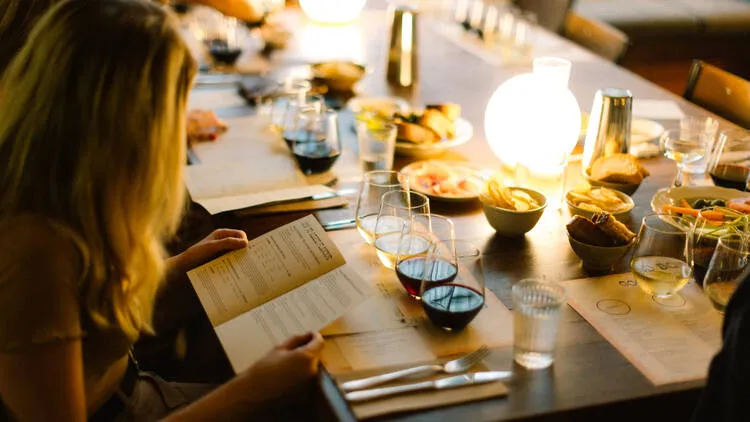
Photo: person reading tasting menu at winery tasting room warm light, via media.timeout.com
Walk into nearly any American tasting room and you will be handed a piece of paper that assumes an education you may not have. Unfired, unfined, single barrel, barrel select, old vine, lees-aged. It reads like a customs declaration for a country you've never visited.
Let me say plainly what the industry mostly will not: this language is, whether by accident or design, a form of gatekeeping. It rewards insiders, flatters regulars, and quietly tells newcomers to nod and order the flight. But it doesn't have to. And across the US craft scene, it increasingly doesn't.
The Big Four, Translated
You do not need a dictionary to read a tasting menu. You need four concepts.
Alcohol by volume (ABV). This is the percentage of the bottle that is alcohol. Wines typically run 12–15%; spirits 40% and up. Higher ABV generally means more warmth and weight on the palate. That's it. That's the whole secret.
Vintage. For wine, the vintage year is the harvest year. A cool, wet year produces leaner wines; a hot, dry one produces riper ones. In regions with variable weather — think Oregon's Willamette Valley — the vintage genuinely matters. In big, consistent regions, it matters less. Either way, an older vintage is not automatically a better one.
Single barrel / single cask. The bottle came from one barrel rather than a blend of many. That means more personality and more variance — the whiskey equivalent of a small-batch hot sauce. Some barrels sing; others merely hum. Fans love the gamble.
Unfined and unfiltered. Most commercial wines are clarified using fining agents and filtration. Unfined wines skip that step, which can mean more texture and flavor — and occasionally a haze in the glass. Cloudiness is not a flaw here; it's a philosophy.
The Buzzword Tier
Below the big four sits a layer of softer jargon. Lees-aged means the wine rested on dead yeast cells, picking up bready, creamy notes. Old vine signals grapes from decades-old vines that yield less fruit but more concentration. Barrel select is a marketing phrase with no fixed legal meaning — a flag to ask questions, not to assume quality.
And then there are the tasting notes themselves. Wet stone. Forest floor. Barnyard. These descriptions sound absurd because they are, slightly. What they are actually describing are aromatic compounds that genuinely occur in fermented grapes — and your job is not to find the barnyard. Your job is to decide whether you like it.
The Rooms Getting It Right
Here is the encouraging part: the friendliest tasting rooms in America are rewriting the script. In Michigan's Leelanau Peninsula, in the Texas Hill Country, in urban tasting rooms from Denver to Detroit, a new generation of hosts is replacing jargon with plain speech. Menus now say things like "bright and citrusy, great chilled" or "this one tastes like campfire, in a good way."
Some producers have gone further, printing two columns on their menus: one for the enthusiasts, with technical details, and one for everyone else, in honest English. It costs nothing. It changes everything. A tasting room that meets you at your level is telling you something important about the people who run it.
Your Permission Slip
So consider this your permission slip, in writing: you are allowed to ask what a word means. You are allowed to say you don't know what lees are. You are allowed to prefer the $22 bottle to the $60 one and to say so out loud. The person behind the counter works there; answering questions is, quite literally, the job.
The best tasters in the world all started knowing nothing. The only difference between them and everyone else is that they kept asking. The menu is not a test. It's an invitation — and now you know how to read it.